



Women's Leather Trench Coats
Showing 21 products
Explore Our Women's Leather Trench Coats
Women's Leather Trench Coats
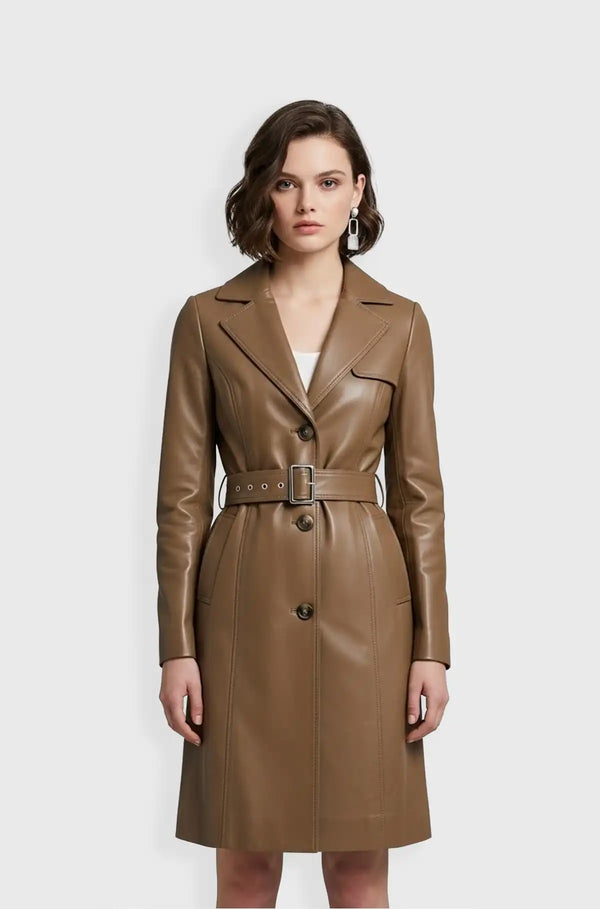
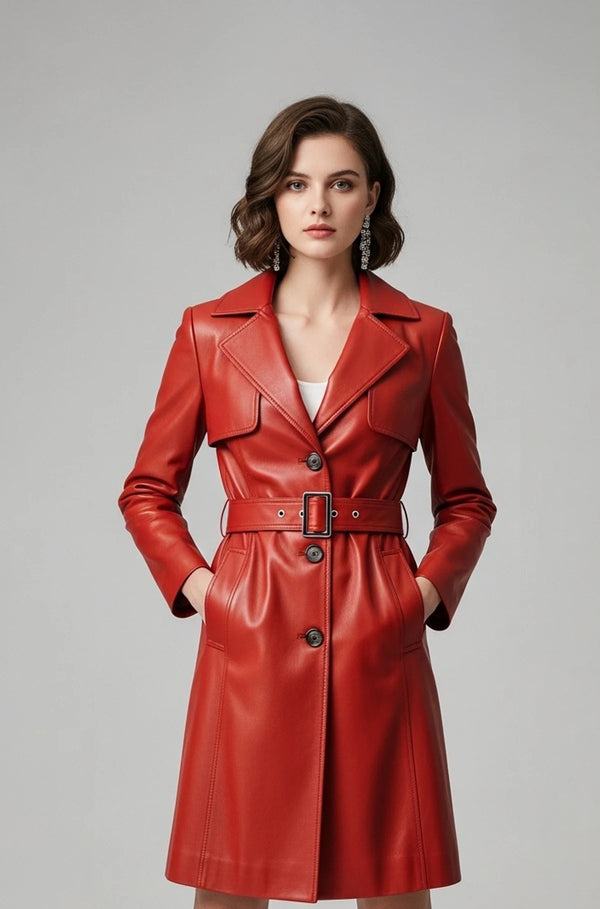
The trench coat was developed for British Army officers in World War I, built as a practical alternative to heavy wool greatcoats for field conditions. Its defining details, the double-breasted front, belted waist, storm flap, epaulettes, and D-ring hardware, each started as functional specifications for combat use. When veterans brought the design home, it transitioned quickly into civilian fashion for both men and women, and has remained one of the most consistently worn outerwear silhouettes for over a century. Fineyst's women's leather trench coats carry that construction in genuine cowhide and soft lambskin, with a structured belted waist, in black and tan, in knee-length and longline cuts.
What the Details on a Trench Coat Actually Do
Every signature detail on an authentic trench coat has a functional origin, and understanding them is part of what distinguishes a genuine trench from a long belted coat that borrows the aesthetic.
The double-breasted front, with two rows of buttons creating an overlapping closure, provides a double layer of fabric across the chest, increasing wind and rain resistance beyond what a single-breasted front can offer.
The storm flap is an extra panel of fabric sitting over the front button closure on the right chest, directing rain away from the seam rather than letting it seep through. It is the detail most closely associated with the trench coat's original waterproofing function.
The belted waist serves both functional and aesthetic purposes: in its military origin, it helped seal the coat against wind at the waist; in contemporary fashion it creates the defined waist silhouette that makes the trench coat one of the most flattering proportional outerwear choices across a wide range of body types.
The epaulettes, the shoulder tabs that button close, were originally used for attaching rank insignia and securing equipment. On a modern trench coat they remain as structural shoulder detail.
D-ring hardware on the belt originated as utility hooks for field equipment. On a contemporary trench coat they are part of the belt hardware.
Cowhide or Lambskin: Two Material Approaches to the Same Silhouette
Fineyst's leather trench coats are available in both cowhide and lambskin, and the choice changes the character of the garment noticeably.
Full-grain cowhide is the more traditional and more structured choice. It holds the coat's shape cleanly, drapes with significant body at coat length, and develops a visible patina and character over time. It is a heavier garment than lambskin, with a more substantial presence on the body.
Lambskin is softer from the first wear, lighter in weight, and drapes more fluidly than cowhide at coat length, reading as more relaxed and fashion-forward than the structured, architectural look of a full cowhide trench. It does not develop the same heavy-handed patina over time but ages more subtly.
Single-Breasted or Double-Breasted: Which Closure to Choose
The traditional trench coat is double-breasted, featuring two rows of buttons and the overlapping front that creates the silhouette most associated with the garment. This remains the more formal and more structurally dramatic option.
A single-breasted leather trench coat takes the same length, belt, and storm flap details but uses a single row of closures for a cleaner, more minimal front line. It reads as the more modern variation on the silhouette and transitions slightly more easily between casual and dressed-up contexts.
Length: Knee or Longline
The most versatile length for a trench coat is knee-length, falling at or just below the knee. It provides meaningful coverage in wind and cold while allowing full stride mobility, and it works equally well over a dress, trousers, or denim.
A longline leather trench coat extending to mid-calf provides more dramatic coverage and warmth. It creates a lengthening visual effect and pairs particularly well with ankle boots or heeled footwear, which keeps the proportion from feeling heavy at the hem.
Caring for a Leather Trench Coat
The belt, elbows, and cuff areas are the points of highest repeated flexion on a long leather coat and the first places where the leather will show drying if it is not conditioned periodically. Use a leather-specific conditioner on the full coat, with particular attention to these crease points, approximately twice a year or whenever the surface begins to look less supple.
If the coat gets caught in heavy rain, blot moisture with a dry cloth and allow it to dry naturally at room temperature, away from direct heat. Condition the leather once it is fully dry.
Store on a wide, structured hanger. For seasonal storage, a breathable cloth garment bag prevents dust without trapping moisture.
Why Choose Our Collection
-
Premium Quality
Crafted with the finest materials for exceptional durability
-
Competitive Pricing
Exceptional value without compromising on quality
-
Fast Shipping
Quick delivery to your doorstep with care
-
Customer Satisfaction
Trusted by customers across 5 countries
Frequently Asked Questions
Are leather trench coats waterproof?
Should I choose a single-breasted or double-breasted leather trench coat?
How is a leather trench coat different from a long leather coat?
What is the belted waist on a trench coat for?
What is the most versatile trench coat length?


Quick Shop (Select your Size)


Quick Shop (Select your Size)


Quick Shop (Select your Size)


Quick Shop (Select your Size)


Quick Shop (Select your Size)


Quick Shop (Select your Size)


Quick Shop (Select your Size)


Quick Shop (Select your Size)


Quick Shop (Select your Size)


Quick Shop (Select your Size)


Quick Shop (Select your Size)


Quick Shop (Select your Size)


Quick Shop (Select your Size)


Quick Shop (Select your Size)


Quick Shop (Select your Size)


Quick Shop (Select your Size)


Quick Shop (Select your Size)


Quick Shop (Select your Size)

Quick Shop (Select your Size)

Quick Shop (Select your Size)























Find your best fits
Receive size recommendations by entering your data for each category
Tops
Size recommendations for shirts, coats, jackets, etc